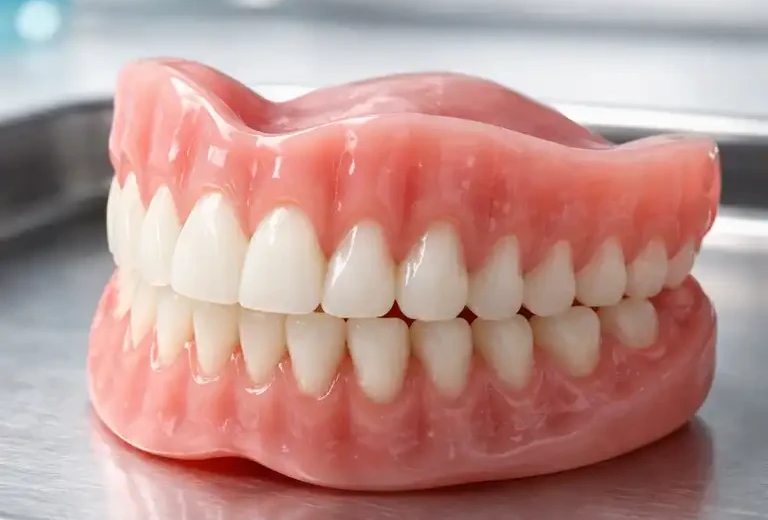
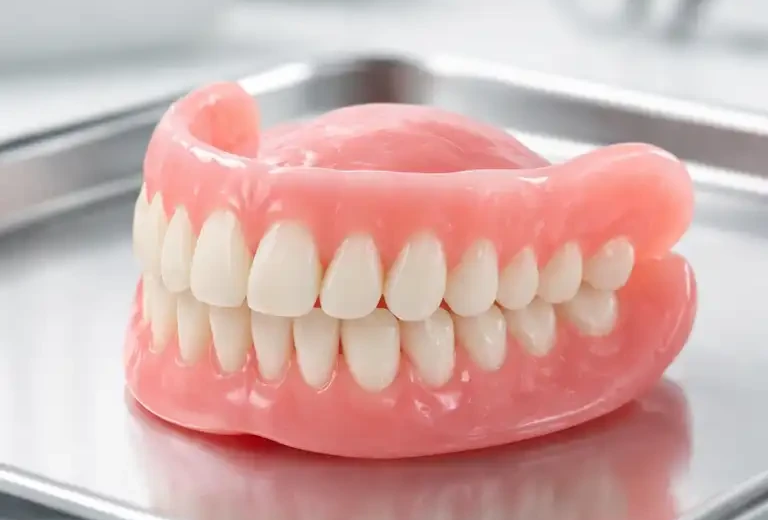
What is a Denture?
Dentures are removable prostheses designed to replace missing teeth. These teeth are usually made from acrylic, metal, or a combination of both, and they have a very natural appearance. Dentures are one of the most common solutions for replacing missing teeth. This method has helped people for many years to have a more beautiful smile and restore the natural function of their mouth.
Types of Dentures
Dentures (removable prostheses) come in a variety of forms, and choosing the right type depends entirely on the number of remaining teeth, the health of your gums, and your budget. Below is a detailed classification of denture types:
1. Complete Dentures
This type is designed for people who have lost all the teeth in one or both jaws.
Conventional: Fabricated and placed after tooth extraction and full healing of the gums (about 8–12 weeks later).
Immediate: Placed in the mouth immediately after tooth extraction so the patient is never without teeth. However, since the gums shrink during healing, these dentures usually require adjustment and relining.
2. Partial Dentures
Used when the patient still has some natural teeth remaining.
Metal framework (Chrome–Cobalt / Cast metal): The main structure is made of strong metal and is attached to natural teeth with clasps. Very durable.
Acrylic (All‑plastic): Less expensive and usually used as a temporary solution because it is thicker and more fragile than metal types.
3. Flexible Dentures
These dentures are made from a special type of nylon and do not have visible metal clasps.
Advantages: Very lightweight, thin, and comfortable; highly natural appearance; lower risk of breakage.
Disadvantages: Higher cost and more difficult to repair if damaged.
4. Implant‑Supported Overdentures
If you are tired of loose dentures, this is one of the best options.
In this method, 2–4 dental implants are placed in the jaw, and the denture “clicks” onto them using attachments or magnets.
Major advantage: Significantly improves chewing power and helps prevent jawbone resorption.
Steps of Fabrication and Placement
The fabrication and placement of dentures is a precise process that usually takes between 3 to 6 weeks and requires 4 to 5 dental visits. The steps are as follows:
1. Initial Examination and Preparation (First Visit)
In this stage, the dentist evaluates the health of your gums and jawbone.
Tooth extraction: If damaged or loose teeth remain, they will be extracted at this point.
Gum healing: If you choose conventional dentures, you need to wait for the gums to heal. If you choose immediate dentures, the next steps begin right away.
2. Preliminary and Final Impressions (Second Visit)
This is the most precise part of the process because the comfort of the dentures depends on it.
Preliminary impression: A general impression of your jaw is taken using a special material (alginate).
Custom impression: A custom tray designed specifically for your mouth is made, allowing highly detailed registration of the gums and muscle attachments.
3. Bite Registration (Third Visit)
In this visit, the dentist determines how your upper and lower jaws fit together.
Measurements: Facial height and the distance between the jaws are recorded.
Tooth selection: With the dentist’s guidance, you choose the color, size, and shape of your new teeth according to your facial structure and age.
4. Wax Try‑In (Fourth Visit)
Before making the final prosthesis, a wax model with the teeth set in place is prepared.
In‑mouth testing: This model is placed in your mouth, allowing you to look in the mirror and speak.
Final adjustments: If you are not fully satisfied with the appearance or speech, changes are made at this stage. After your approval, the model is sent to the lab to be converted into the final denture (plastic or metal‑based).
5. Delivery and Final Placement (Fifth Visit)
The final denture is fabricated and placed in your mouth.
Fine adjustments: The dentist identifies and adjusts any areas that might cause pressure or discomfort.
Instructions: You are taught how to insert, remove, and clean your dentures.
Important Notes After Placement:
Follow‑up visit: Typically, 24 to 48 hours after delivery, you should return for a check‑up. If any areas of your gums appear red or irritated, the dentist will adjust the denture accordingly.
Patience and practice: During the first days, speaking or eating may feel unusual. This is completely normal, and your tongue and cheek muscles will soon adapt.
Quality Indicator | Conventional / Non‑specialized Centers | Our Clinic’s Specialized Services | Result for the Patient |
Tooth Material | Ordinary and opaque plastics | Nano acrylic and reputable brands (German/Italian) | Completely natural appearance and high resistance to wear |
Impression Accuracy | Single‑step and quick impression | Customized two‑step impression (PVS) | Maximum adhesion and prevention of denture loosening |
Facial Design | Straight and uniform arrangement | Smile design tailored to facial shape and age | Facial rejuvenation and correction of sunken areas around the mouth |
Comfort and Gums | High risk of sores and inflammation | Polished edges and microscopic adjustments | Complete comfort while speaking and eating |
Hygiene and Odor | Absorbs bacteria and develops bad odor over time | Dense and anti‑absorption material (High Density) | Fresh breath and preservation of gum tissue health |
Post‑Delivery Services | Limited or no support | Free adjustment sessions and periodic check‑ups | Long‑term confidence in proper denture function |
Why do these differences matter?
1.Stability in the mouth: Our precise impression technique allows the denture to adhere to the gums like a “suction cup,” preventing movement while smiling or speaking.
2.Natural color: Our teeth feature translucency (edge transparency) that reflects light exactly like natural tooth enamel.
3.Chewing power: By accurately adjusting the bite (how the jaws come together), pressure is distributed evenly and your chewing ability improves by up to 80%
We are here to help you make the best decision. To receive a free professional consultation and book an appointment with Dr. Hesam Nazari, please use the following methods:
Contact the Clinic (Landline): ☎️ +987153341322
Mobile & Urgent Consultation: 📱 +989031408680
Online Request: Fill out the form below, and our experts will contact you as soon as possible. 📩
Our commitment is to provide safe and painless services for your healthy smile. 🌿
Table of Contents
“All dental services, from general to cosmetic and specialized, are provided at this clinic. Below you can see some of the services.”
Aligner
(Invisible orthodontics)
Dental implant
(Dental implantation)
Dental laminate
(Cosmetic crown)
Composite veneer
(Composite crown)
Pediatric dentistry
(Pediatric dentistry)
Cosmetic dentistry
(Cosmetic dentistry)
General dentistry
(General dentistry)
Dental scaling
(Dental cleaning)
These are some of our main services.
To view the full list of services and details of each treatment, visit the Services page

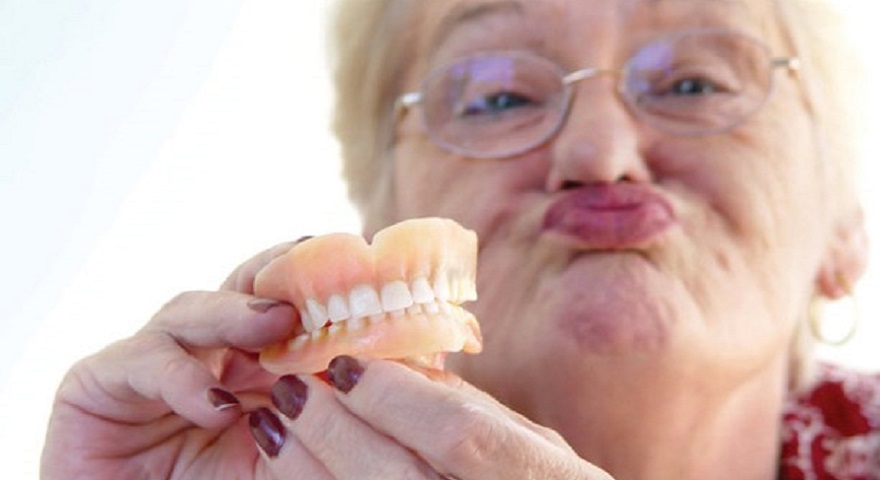
Denture Care
Proper care of dentures not only increases their lifespan (between 5 to 7 years), but also prevents gum infections, bad breath, and painful inflammations.
Here is a complete guide for daily maintenance:
1.Daily Cleaning (The Most Important Part)
Dentures, like natural teeth, accumulate plaque and attract bacteria.
After each meal: Remove the denture from your mouth and rinse it with warm water (not hot!) so that food debris is removed.
Special brushing: At least once a day (preferably before sleep) wash the denture with a soft (Soft) brush specifically designed for dentures.
Proper cleanser: Never use regular toothpastes! The abrasive particles in toothpaste create scratches on the prosthesis. Use mild liquid soap or very diluted dishwashing liquid.
2.Night Rest (8‑Hour Rule)
The gum tissue under the denture is under pressure and needs rest and blood circulation.
Removing the denture: Never sleep with dentures. This greatly increases the risk of oral fungal infection (thrush).
Moist environment: Dentures must not dry out (because they change shape). At night place them in a container of lukewarm water or special denture‑cleaning tablet solutions.
3.Care of Gums and Mouth
Even if you have no natural teeth, oral hygiene is not suspended!
Gum massage: Before inserting the denture in the morning, clean your gums, tongue and the roof of your mouth with a very soft brush or a clean damp cloth. This stimulates blood flow in the gums.
4.Handling Precautions
Dentures are very fragile against impact.
Safety recommendation: When cleaning the denture, do it over a soft towel or a container filled with water. If the denture slips from your hand and hits the ceramic sink, it will immediately crack or break.
5.Prohibitions (Care Do‑Nots)
Boiling water prohibited: Very hot water causes warpage of the denture plastic and it will no longer fit properly in the mouth.
Bleaches (bleach) prohibited: Using strong whitening agents causes discoloration of the pink part (artificial gum) and weakens its structure.
Self‑treatment prohibited: If the denture becomes loose or its edge becomes sharp, never attempt to repair it with a file or household instant glues. This will cause permanent damage to the prosthesis and your gums
Advantages of Dentures
Using dentures goes beyond a simple cosmetic change; these prostheses have a profound impact on quality of life, physical health, and even a person’s self‑confidence. Here are the most important advantages categorized:
1.Significant improvement in appearance and beauty
Maintaining facial form: When teeth are lost, the facial muscles gradually sag and a person appears older. Dentures support these muscles and prevent wrinkling around the mouth.
A natural smile: New technologies have made it possible for prostheses to be made very similar to natural teeth, so that it is difficult for others to recognize them.
2.Restoration of chewing ability and proper nutrition
Better digestion of food: The absence of teeth prevents a person from grinding food properly, which leads to digestive problems. Dentures allow you to consume a wider range of foods (fruits, vegetables, and proteins).
Reduced dietary restrictions: Unlike when you have no teeth, with dentures you can once again enjoy eating many foods.
3.Improvement in speech and pronunciation
Correct pronunciation of words: Teeth play an important role in pronouncing sounds such as “s”, “sh”, and “f”. Replacing teeth allows the tip of the tongue to have support and eliminates lisping or whistling during speech.
4.Cost‑effective
Affordable price: Compared with methods such as extensive implants (which have very high costs), dentures are an economical and accessible solution for restoring oral function.
No need for major surgery: Most denture models (except overdentures) do not require complex and invasive surgeries.
5.Increased self‑confidence and mental well‑being
Social interactions: Many people avoid smiling or speaking in public because of missing teeth. Dentures break this barrier and give you a better feeling about yourself.


When should you visit the dentist?
Many people think that after receiving dentures, there is no longer any need to visit the dentist; however, due to the continuous changes in the gum tissue and jawbone, periodic check‑ups are essential.
If you notice any of the following, be sure to visit as soon as possible:
1.Looseness and lack of stability (Loose Fit)
If the denture moves while speaking, laughing, or chewing food, or falls out of the mouth, it is a sign that your jawbone has changed shape and the prosthesis no longer fits it properly. This condition can lead to faster bone loss.
2.Pain and sore spots (Sore Spots)
The appearance of sores, redness, or inflammation in the gums is a sign of abnormal pressure from the denture. The dentist can eliminate this pressure by making minor adjustments to the edges of the prosthesis.
3.Changes in speech and pronunciation
If you suddenly notice that you whistle while speaking or you do not pronounce words as clearly as before, your denture may have shifted from its original position or settled.
4.Changes in facial shape
If you feel that your lips or cheeks have sunk inward or the distance between your chin and nose has decreased, it means the denture has lost its effectiveness in supporting the facial muscles and needs reconstruction or replacement.
5.Structural damage (cracks or fractures)
Even if you see a very small crack on the body of the denture, visit the dentist. Using a cracked denture can cause serious damage to the gums.
Warning: Never use household instant glues or adhesives to fix the denture; the chemicals in these glues are toxic to oral tissues.
6.Persistent bad odor and discoloration
If despite regular washing the denture has a bad smell or dark stains appear on it, it indicates that bacteria and plaque have penetrated into the pores of the prosthesis and it must be professionally cleaned (Ultrasonic Cleaning).
7.Passage of time (5‑year rule)
Even if you have no problems, specialists recommend replacing your denture every 5 to 7 years; because the prosthesis material gradually weakens over time and loses its hygienic effectiveness.
💬 Free Initial Consultation & Examination 🩺
✨ For a free specialized consultation and to book an appointment with Dr. Hesam Nazari, please contact us through the following methods:
📱 Mobile Consultation: +989031408680
☎️ Clinic Phone: +987153341322
📍 Address: Iran, Fars, Fasa, Shahzadeh Ghasem Square, opposite Asieh High School, Dr. Hesam Nazari Clinic
🕐 Working Hours: Saturday to Wednesday (8:00 AM – 22:00)
Thursday, Friday & Public Holidays: Closed
📩 Please fill out the form below for online booking, and we will contact you as soon as possible.

Why is our clinic the best choice for making dentures?
Creating dentures is not just a technical procedure; it is a combination of dental artistry and precise engineering. Choosing our clinic ensures a satisfying smile and long‑term comfort for the following reasons:
1.Use of premium materials and reputable brands
We use high‑quality acrylic materials and artificial teeth (such as German or Japanese brands) that:
Do not discolor and are highly resistant to wear.
Have a very natural appearance (natural translucency and shine).
Do not absorb unpleasant odors and are hypoallergenic.
2.High precision in customized impressions
Many cases of denture looseness and oral sores are caused by rushed impressions. In our clinic:
A two‑step impression technique and custom trays are used so the prosthesis fits precisely on the contours of your gums.
Human error is minimized and the denture feels stable from the very first day.
3.Smile design tailored to your facial features (esthetic analysis)
We do not simply “line up” the teeth.
The arrangement of teeth is designed according to your facial shape, age, and even skin tone to make your face look younger and to restore the natural fullness lost due to missing teeth.
4.Collaboration with the most reputable specialized laboratories
The final result depends not only on the dentist but also on the laboratory technician. We collaborate with laboratories that use modern technologies in denture processing to prevent deformation (shrinkage) during fabrication.
5.Post‑delivery support and adjustments
We do not leave you on your own after delivering your dentures.
Follow‑up check‑ups and precise readjustments are performed in our clinic to ensure that even the smallest pressure or irritation on your gums is eliminated
Conclusion:“Your smile is the signature of our expertise.”
Choosing dentures is not merely a replacement for missing teeth; it is a return to the days when you could smile without worry and enjoy your meals with confidence. At our clinic, by using the most precise impression technologies and the best modern materials available worldwide, we are committed to creating a prosthesis that not only harmonizes perfectly with your facial appearance but also becomes a natural part of you in terms of comfort and stability. Our goal is that no one will notice that your teeth are artificial.
We understand that adapting to dentures can be challenging. That is why we stand by your side throughout every stage of fabrication and even after delivery. By entrusting the design of your smile to our professional team, you can say goodbye to problems such as loose dentures, gum sores, and persistent bad breath
All dental services — from A to Z — are provided in this clinic. Below, you can see a selection of the main treatments.
Impacted Wisdom Tooth Surgery
(Impacted Wisdom Tooth Surgery)
Wisdom Tooth Surgery
(Wisdom Tooth Surgery)
Oral and Maxillofacial Surgery
(Oral and Maxillofacial Surgery)
Root Canal Treatment (Endodontics)
(Root Canal Treatment)
Intraoral Scanner
(3D Scanning)
Periodontics
(Gum Treatment)
Orthodontics
(Jaw and Teeth Correction)
Dental Composite
(Composite Restoration)
You can see a selection of our clinic services here; for the full list, please visit the Services page.

“Let’s go to Instagram!”
“Join Dr. Hesam Nazari’s family on Instagram and follow us.”